


In our modern world, one question stands out: is language technology? Language is more than a communication tool; it is a human invention that shapes thought, preserves knowledge, and supports innovation. Technology includes systems and methods that improve abilities and solve hard problems, not only machines or digital devices.
This article explores the relationship between language and technology. We will trace spoken and written forms and study why language as a technology has remarkable structure. We will examine its effects on cognition and culture, along with its link to artificial intelligence.
Language also works as a biological and social construct. As a flexible symbolic tool, it organizes thought and coordinates behavior. Studying linguistic technology reveals its power to shape human life.
Key Takeaways
- Language serves as a crucial tool for organizing thought and behavior.
- It is both a biological and social construct, shaping culture and cognition.
- Language can be viewed as a technology that enhances human capabilities.
- The evolution of language includes both spoken and written forms.
- Artificial intelligence intersects with language, showcasing its technological aspects.
1. Defining Language as a Technology: Is Language Technology in the Modern Sense?
Language is a basic technology that shapes modern interactions and perceptions. To understand this idea, we must explore what “technology” means in a linguistic context.
People often see technology as hardware or tools, but its meaning reaches much farther. It includes organized knowledge, repeatable procedures, and symbolic systems that extend human abilities.
1.1 What Does “Technology” Mean in a Linguistic Context?
In linguistics, technology can have a broad meaning. It includes frameworks such as writing, mathematics, and communication systems. These frameworks help people express complex ideas and emotions.
The language technology definition goes beyond physical tools and includes systems for clear, meaningful communication.
1.2 The Fundamental Question: Is Language Technology?
At the center of this inquiry is a key question: Is language a form of technology? To answer, we must see how language meets several technological standards.
It has established rules, reusable structures, and learned conventions. These elements let us create unlimited messages from a limited set of components.
Related Posts:
- What Is MuleSoft Technology? How It Connects…

- Is Technology Important in Education Benefits and Challenges

- How Technology Affects Social Development Impact on…

- How Technology Keeps Us Connected Bridging Distances…

- De-Hy Technology An Overview of Dehydration Technology

- What Is Medical Technology Innovations in Healthcare

1.2.1 Defining Technology Beyond Physical Tools
Language works as a technology that changes with society. Vocabulary, grammar, and writing systems develop to meet social and practical needs.
This flexibility shows that language is a cognitive technology that helps people classify and reason about their experiences.
1.2.2 Language as a Cognitive and Social Technology
Moreover, language acts as a social technology that helps groups coordinate and preserve shared knowledge. Although language serves technological functions, it is not simply a machine.
Instead, it works through symbols, rules, and collective use, shaping our interactions and cultural identity.
2. The Historical Evolution of Language as a Tool
The history of language shows language as a tool for human interaction. This journey begins with the origins of spoken language, which helped people bond, cooperate, and pass on knowledge.
2.1 Origins of Spoken Language
The exact origins of spoken language remain uncertain, but its adaptive value is clear. Early humans relied on vocal communication to share information, plan hunts, and strengthen social ties. This form of communication laid the groundwork for more complex systems of expression.
2.2 The Invention of Writing Systems
As societies grew, people needed more lasting ways to communicate. The invention of writing marked a pivotal moment in the history of language. Cuneiform in Mesopotamia, Egyptian hieroglyphs, and Chinese characters stored memory outside the mind, supported administration, enabled contracts, recorded laws, and shared information beyond its original context.
2.3 The Printing Press and Mass Communication
The advent of the printing press in the fifteenth century, particularly through Johannes Gutenberg’s innovations, revolutionized communication. It enabled mass communication through mass-produced texts, supported literacy, and spread ideas. It played a vital role in religious reform, scientific exchange, and political movements.
2.3.1 From Oral Traditions to Written Records
Although the shift from oral traditions to written records transformed communication, spoken language remained important. Instead, each medium expanded language’s functions, enriched human interaction, and preserved knowledge across generations.
3. Core Characteristics That Make Language a Technology
Language has core traits that make it a powerful technology. These characteristics improve communication and help people understand one another. Studying the characteristics of language shows how it works as technology in daily life.
Systematic Structure and Rules
The systematic structure of language is a defining feature. Language includes phonology, morphology, syntax, semantics, and pragmatics. Together, these parts form a linguistic framework for building and understanding messages. Even a new sentence can make sense because speakers share language structure and grammar rules.
Adaptability and Innovation
Languages keep changing by absorbing loanwords and creating terms for social, scientific, and technological advances. For example, the rise of the internet introduced terms like “blog,” “hashtag,” and “streaming.” This language innovation keeps language relevant and helps people express modern concepts.
Problem-Solving Capabilities
Problem-solving through language helps people explain challenges, explore alternatives, and negotiate solutions. It also lets people model hypothetical scenarios and coordinate collective actions. These abilities make language indispensable to human interaction.
Grammar as a Technological Framework
Grammar functions as a technological framework that organizes symbols into meaningful relationships. Grammar is not merely a set of restrictions; it enables complex expressions. It helps people share intricate ideas and emotions, showing language’s technological qualities.
4. Language Compared to Other Human Technologies
Language is a remarkable human invention and human technology that shares traits with material technology. Both are shaped by human needs and rely on learned procedures. These human technologies improve through experimentation and can strengthen individual or collective abilities.
Language tools, like physical tools, can be chosen and adapted for many tasks. These tasks include teaching, persuasion, planning, storytelling, and technical communication. Its adaptability lets language work through speech, writing, gesture, print, radio, video, and digital platforms.
Similarities with Material Technologies
Language and material technologies both support human interaction and expression. They meet specific needs and can change over time. For example, a new tool may raise productivity, while a new word or phrase may improve communication.
Differences from Conventional Technologies
Material technologies usually have physical parts and measurable limits, but languages develop through social use and keep changing. Unlike conventional technology, a language needs no factory to exist. However, writing systems, keyboards, and software can materially support language use.
The Unique Nature of Symbolic Systems
Words do not physically resemble the objects or ideas they represent. Their meanings depend on shared conventions among users. These symbolic systems set language apart from other technologies and highlight social interaction’s role in shaping it.
| Aspect | Language | Material Technology |
|---|---|---|
| Nature | Abstract, symbolic | Tangible, physical |
| Creation | Socially constructed | Engineered and manufactured |
| Adaptability | Highly adaptable | Limited by design |
| Medium | Multiple forms (speech, writing) | Single form (physical object) |
| Change | Continuous evolution | Stable unless modified |
5. The Role of Language in Cognitive Development
Language shapes cognitive abilities by helping people label experiences, group information, and express relationships. This link between language and thought helps explain how we process and organize experience. Language guides attention and concepts, but thoughts can also use images, sensations, and emotions.
Understanding cognitive development means studying how language acquisition unfolds, especially in children. Child language acquisition is more than learning words; it is a social and developmental journey. Children learn through interaction, imitation, and meaningful participation, moving from single words to complex grammar and stories as abstract thinking grows.
Language and Thought
The relationship between language and thought is complex. Language gives thoughts a structure, while also shaping how we think. This verbal reasoning helps us reflect and practice self-regulation.
Language Acquisition in Children
Language acquisition begins in infancy. Children absorb sounds and patterns from their surroundings, gradually building an understanding of language. Social interaction helps them communicate, as shown by Vygotsky language theory, which stresses social context in language learning.
Vygotsky’s Theory of Language and Cognition
Lev Vygotsky linked language development with cognitive growth. His zone of proximal development explains how children complete tasks with caregiver and peer support. This teamwork helps children move beyond current abilities and build cognitive skills.
Vygotsky said social speech can become inner speech, supporting self-regulation and problem-solving. As children internalize language, they learn to plan and complete tasks independently. This change shows how language acts as cognitive technology, helping people build and manage thoughts.
| Aspect | Language Role | Cognitive Impact |
|---|---|---|
| Labeling Experiences | Facilitates understanding | Enhances memory retention |
| Social Interaction | Encourages participation | Promotes verbal reasoning |
| Inner Speech | Aids self-regulation | Improves problem-solving |
6. Language as a Medium for Cultural Transmission
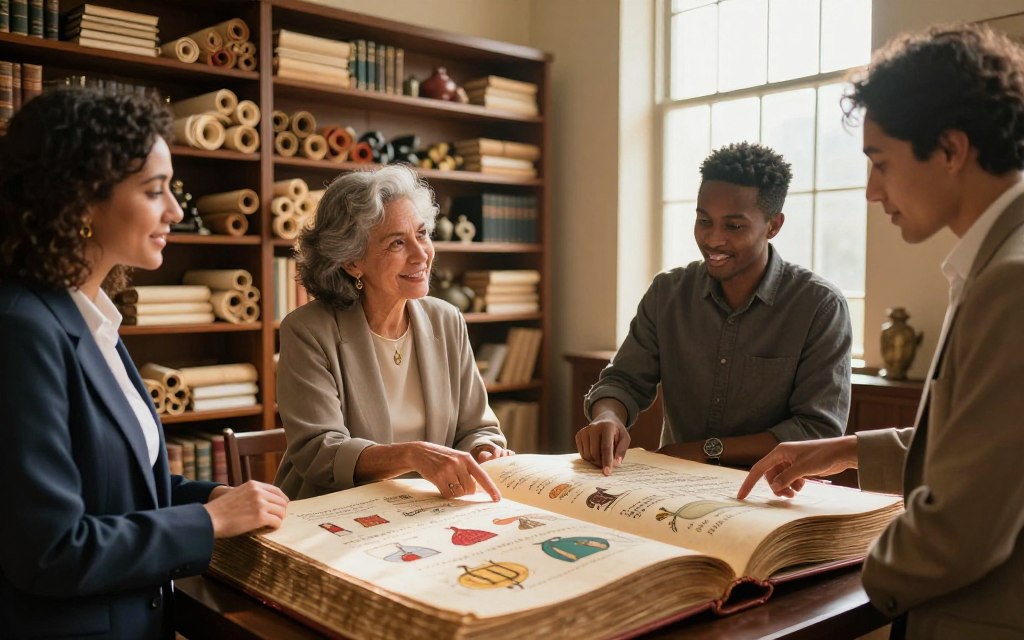
Language supports cultural transmission across generations. It preserves knowledge, traditions, and identities. Oral histories, myths, songs, and proverbs keep each community’s heritage alive through shared stories and practices.
Preserving Knowledge Across Generations
Oral traditions share intergenerational knowledge within communities. They include stories, ecological wisdom, craftsmanship techniques, and legal traditions. These narratives live in community languages, making them inseparable from cultural identity.
Written records, recordings, and digital archives support language preservation. They help communities document languages and cultural practices, so knowledge remains available. Yet cultural knowledge depends on context and community participation, not words alone.
Language and Identity
Language and identity are closely linked. People’s language choices can show belonging to communities shaped by ancestry, region, profession, or religion. Bilingualism, code-switching, and dialects show rich cultural expression; celebrate these variations instead of treating them as deficiencies.
Endangered Languages and Cultural Loss
The loss of endangered languages threatens cultural diversity and linguistic diversity. When a language disappears, unique classifications, historical memories, and oral literature may disappear too. This loss weakens communities’ relationships with their environments and erodes cultural heritage.
This issue requires sensitivity. Communities are not passive victims; they actively lead revitalization efforts.
Language education, documentation, and digital tools can support these initiatives. Language preservation means more than saving vocabulary or grammar; it nurtures the people and cultural practices that give language meaning.
7. Digital Age: Language and Modern Technology Convergence
In today’s digital landscape, language and technology meet more closely than ever. The rise of natural language processing (NLP) has changed how we interact with machines.
NLP lets computers handle speech recognition, sentiment analysis, and text classification. These advances use artificial intelligence and language to support more natural communication.
The digital age has also created new ways to communicate, especially through social media. On these platforms, social media language changes quickly through hashtags, memes, and emojis.
These features are not simply informal or incorrect. They adapt to the limits and settings of digital communication. As users create content, they shape language around current trends and social norms.
Machine Translation and Global Communication
Machine translation shows how technology can support communication across languages. Automated systems help users cross language barriers, but challenges remain.
Idioms, cultural references, and tone can make translations difficult. Automated systems also raise concerns about bias and privacy, which may reduce their reliability.
Despite these challenges, machine translation and language technology today expand human communication. They create new ways to process and share language, helping it evolve with technology. Digital platforms do not replace language as a technology; they strengthen it and change how we use it.
8. Linguistic Relativity and Technological Influence
Technology’s influence on language reveals how society changes. The idea of linguistic relativity connects closely with the Sapir-Whorf hypothesis. This view says language can shape habitual thought, attention, and interpretations of the world.
Linguistic relativity has two main forms. The first, strong linguistic determinism, controversially claims language rigidly limits thought. The second, more widely accepted form, says language patterns make certain distinctions more noticeable or convenient.
Color and spatial categories show how cultures may organize experience differently. These differences can influence how people perceive and interact with their environment.
The Sapir-Whorf Hypothesis
The Sapir-Whorf hypothesis offers a framework for understanding language and thought. It shows how linguistic structures can affect cognitive processes. Some languages have multiple words for “snow,” so speakers may experience snowy places differently from speakers with one term.
How Technology Shapes Language
New tools show how technology shapes language by creating communication needs and social practices. Digital platforms introduced terms like “stream,” “viral,” “DM,” “cloud,” “platform,” and “algorithm.” These words entered our vocabulary and gained new meanings online.
Digital Communication and New Linguistic Forms
Online communication has created new digital language forms. Emojis, GIFs, hashtags, and voice notes have changed how we express emotions and ideas. Auto-complete suggestions and short-form messages also influence language use.
The relationship between technology and language shows reciprocal language influence. Users adapt language to digital interfaces, while language shapes platform design and information organization. Platform architecture can favor brevity or emotional immediacy, influencing communication styles.
Linguistic relativity and technological influence offer a rich area for exploration. Understanding how technology shapes language offers insight into ongoing linguistic change and communication’s evolution.
9. Philosophical Perspectives on Language and Technology
The philosophy of language and technology examines how language and tools shape communication and social structures. Studying their connection can reveal how societies communicate and organize themselves.
9.1 Heidegger’s View on Language and Technology
Martin Heidegger presents a distinct view of modern technology. He sees it as a way of revealing that treats people and the world as resources for control. This Heidegger technology view matters because names and frames shape what society notices or values.
9.2 McLuhan’s “The Medium Is the Message”
The phrase McLuhan medium is the message explains how communication tools shape social habits and perceptions. It reaches beyond content, shaping views of speech, print, television, social media, and generative AI. Each medium changes our interaction with language, showing how technology and meaning connect.
9.2.1 Contemporary Philosophical Debates
Today, AI-generated language raises questions about whether it shows true understanding. Who controls linguistic data, and how do automated systems affect authorship and trust?
Do digital interfaces expand or limit human agency? These questions belong to communication philosophy and help us judge the ethics of language technology.
| Philosopher | Key Idea | Implication |
|---|---|---|
| Heidegger | Technology as revealing | Influences perception of reality |
| McLuhan | The medium is the message | Shapes communication habits |
| Contemporary Debates | AI and language understanding | Challenges authorship and trust |
As we consider these views, we should recognize the practical value of language technologies. Still, we must examine how their design shapes knowledge, power, identity, and responsibility.
10. Conclusion
To understand whether language is language technology, we need a broad view of technology. Language as a human technology strengthens human abilities and supports social interaction, unlike conventional machines. It grows from biology and culture, while users shape its changing system over time.
The language and technology relationship works both ways. Language helps us create technologies, and technologies change our communication habits and cultural exchanges. Speech supports cooperation, writing externalizes memory, grammar organizes thought, and digital platforms expand communication with greater speed and access.
Looking toward the future of language, artificial intelligence and machine translation will further change communication. Speech interfaces and digital preservation efforts will represent diverse languages and communities. This progress shows why inclusive systems must respect linguistic diversity.
Ultimately, language is more than a mechanical tool. It is one of humanity’s most powerful cognitive and social technologies and functions as communication technology. This view shows the importance of the language and technology relationship in linguistics, culture, education, and the future of communication.